About an hour before call time, the theater was still empty. So far, only about eight people had arrived, and Ms. Stephanie Young sat quietly in her room backstage, sipping an energy drink from her favorite mug. She was here on the weekend, and the schedule was packed. Today, she knew would be at the theater for at least eight hours.
Still having not eaten, she opened up a bag of plain bagels sitting on her desk, took one out and poured a bag of Goldfish onto it. She took a few bites of her crafted breakfast, wrapped it up and got back to work.
It was the middle of tech week for “Into The Woods,” and today’s agenda included two run-throughs of the entire show. For the past week, she had been spending her entire days at the theater. It was a tiring job; sometimes, she would forget microphones were muted, sometimes she would leave her mug sitting onstage and sometimes she would forget why she even went somewhere. Still, there were plenty of things to do this week—the show must go on. She gathered her things and headed upstairs to the sound box.
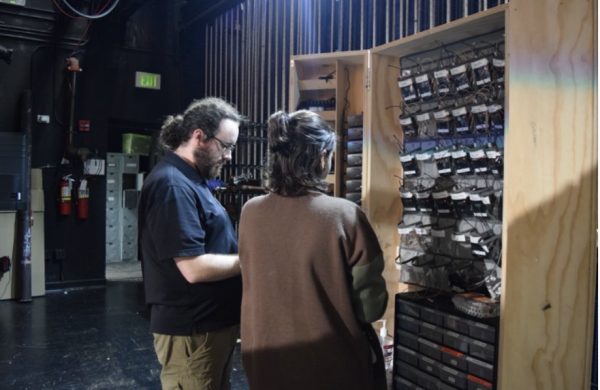
“This show is a lot more stressful [than other ones I’ve worked on],” Ms. Young said. Having worked in theaters for more than five years, that was saying a lot. Ms. Young just graduated college in 2023, and she was used to having someone to turn to and ask, “How does this work?” Now, she was working with a brand new sound system only she knew how to use and was also now responsible for any issues that came with it. Now, she was in that position of a teacher.
On top of this, Young has had little time to prepare for the show. She only started work at Heritage this past summer, and in just a few months, she was trained on the new system, learned how to use the sound board and was filled in on what the theme for “Into the Woods” was. Immediately, she started designing sound for the show and several other acts. Meanwhile, Young also had the responsibility of handling students. “In college, I had to go to two classes [a day],” she said, “Now, I’m teaching four a day.”
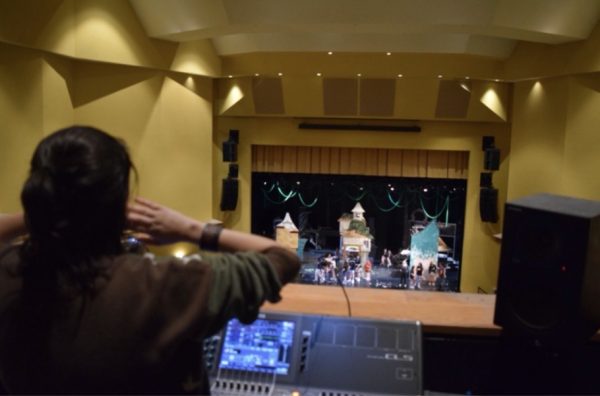
At the Heritage main theater, the sound box is on a small balcony, three levels up, at the back of the auditorium. It’s a mess of electronics cables and cardboard boxes, and to someone not familiar with it, it’s hard to understand what’s going on.
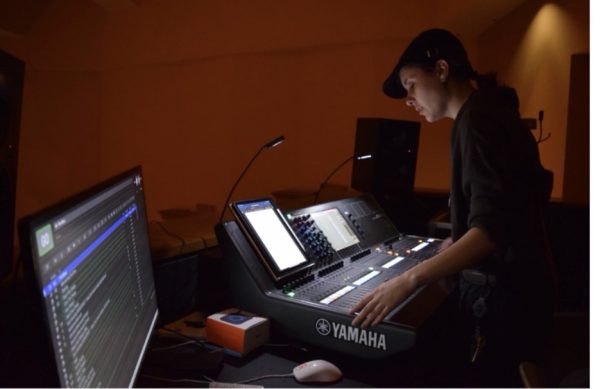
Settling in before the show with her student co-operator, she moves a worn, upholstered barstool up to a center table and switches on the fancy new sound board: a piece of tech full of different kinds of knobs and buttons that looked like it came off a spaceship—that was Ms. Young’s canvas for the art of sound design. She reached for her bag and plugged in a flash drive, pressing a few buttons to make the board spring to life, its displays lighting up and dials sliding into their programmed places.
She looked down onto the stage, which she now had a wide view of, and noticed the background lights were flashing on and off in random colors. Something was wrong, but unconcerned, she kept her focus on her desktop. Ms. Young is a sound designer, and although this was an issue, she was exhausted. And even if she wasn’t, she still had no idea how to fix it. “It was a problem for the lighting people,” she said … the lighting people who weren’t here today. Apparently, it wasn’t just Ms. Young having a stressful time preparing for the show. The rest of the rehearsal would go on with the background flicking different shades of pink and purple.
“With sound designers, once they make all of the cues, the sound effects and the mic lists, they’re done. But I’m not just the sound designer; I’m also the sound mixer,” Ms. Young said. Sound mixing means testing microphones, adjusting levels and running the sound during a live performance.
This area of work comes with its own set of challenges, though, and its problematic nature usually makes it Ms. Young’s least favorite part of working on the show. “Once I fixed something,” she said, “another thing would break. Or when I thought it fixed something, I didn’t actually fix it.”
During some rehearsals, actors’ microphones would produce loud feedback or stop working on stage. Every time, Ms. Young would look fed up with the board and would try to fix it the next day. Her efforts wouldn’t always succeed—that’s just what it was like being a sound mixer.
After a few minutes, Young’s signal to start rehearsal came when the lights dimmed and a spotlight illuminated the stage. Quickly, with a few clicks of a mouse, she queued the opening song. Her full attention was on the board for the next two hours, ensuring the act ran smoothly by clicking, switching, and adjusting the right knobs and sliders at the right times.
There was constantly something to do, and it kept her standing up and moving across the sound box the entire show. Occasionally, there would be a point where Young could relax for a moment and take a seat, but when a new scene began, she was right back up.
“Just like with almost every design, sound design can immerse the audience even more … take them a step further,” Young said. “What sound can do in a show is bring the audience more into that world. You can have something to look at, but if you can hear it, too, it will put you into a world.” She also mentioned how sound can bring things that aren’t actually real to life. “For example, with a giant’s footsteps, those don’t exist,” she said, referencing the scene in “Into the Woods” where a giant is heard stepping on characters out of view. “But it can exist because sound makes it happen in the theater.”
Despite all the stress, as a sound designer, Ms. Young has experienced some really great moments. “I remember a really cool thing I did once that’s always stuck with me. It was a scene in ‘Sweat’… and there’s a jukebox in this bar. I had transition music playing, and then had it fade into the jukebox at the start of the scene. It went so perfectly. It was almost as if you could see the music go into the jukebox.”
Most days during tech week, Ms. Young would go home exhausted. And on the day before opening, all she could wish was that “Into the Woods” would go smoothly. “I really hope it will run well … but I can’t know for sure.” As a sound designer, Young never knows what will happen. “Things can always go wrong,” she said. But it’s the unpredictability that makes the job exciting; that keeps her going.